
As I wrote about in my first blog article in this series, learning about Yacouba Sawadogo many years ago was one of the early sparks for my interest in ecological restoration. The idea that one can modify the shape of the ground to capture rainfall and bring life back to a landscape was so exciting to me.
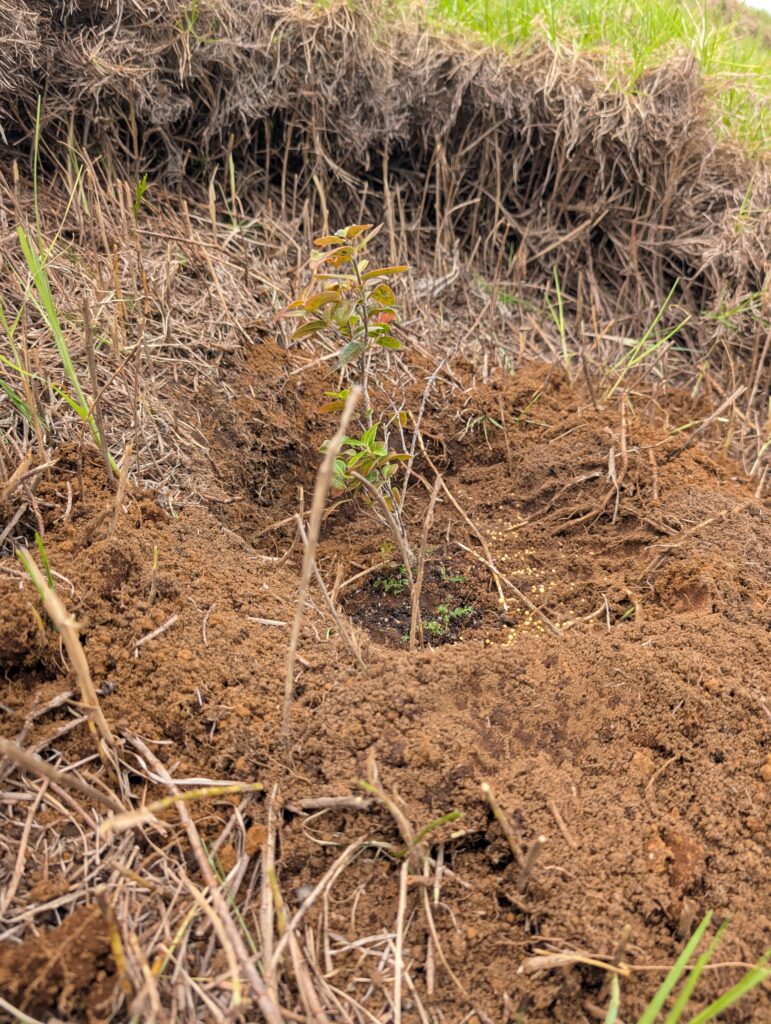
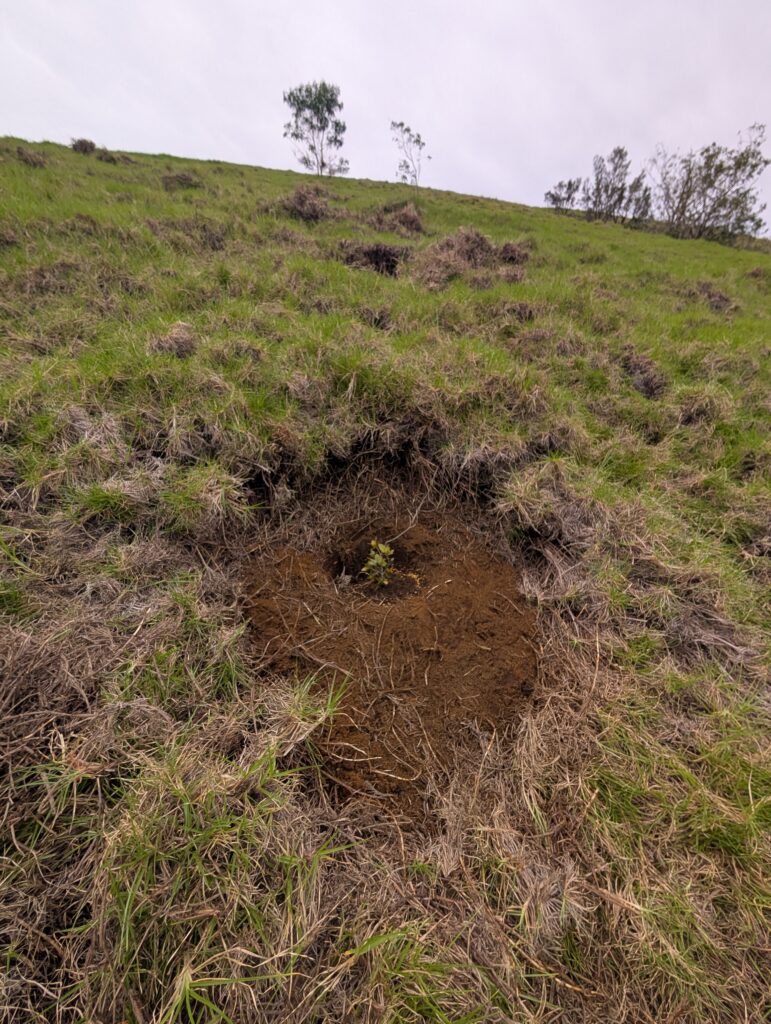
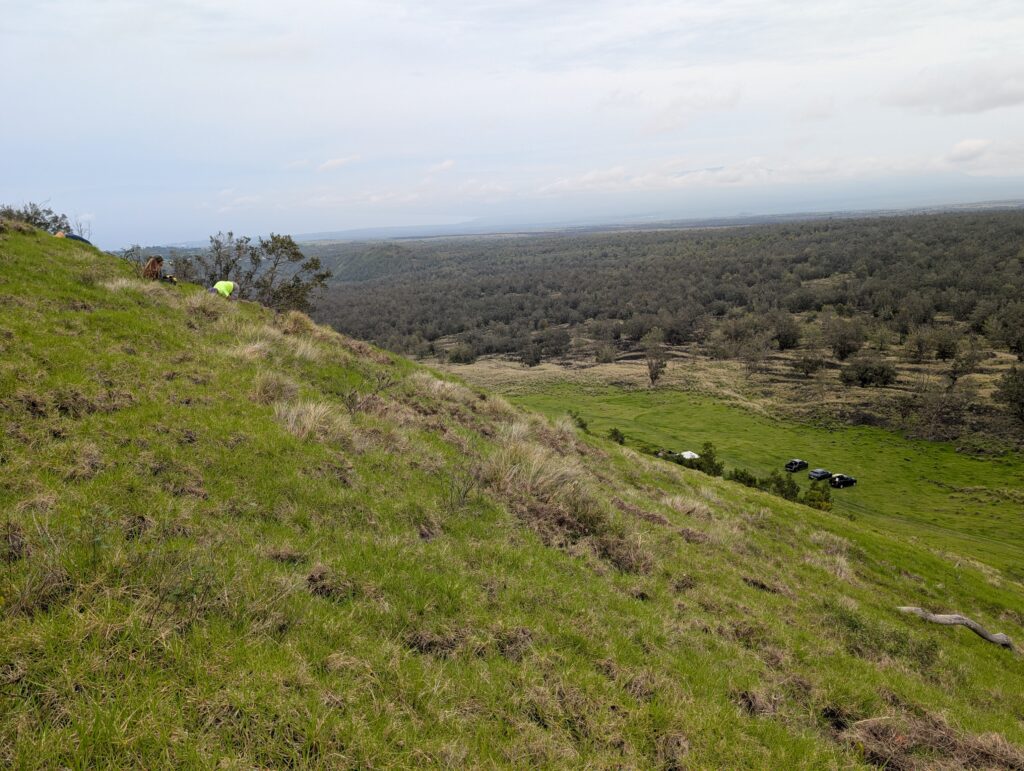
Fast forward to last September. I had the opportunity to spend a day out in the field with Kaiāulu Pu‘uwa‘awa‘a, an 84-acre restoration project in a semi-arid part of the Big Island, Hawai‘i. We were planting the native Hawaiian tree ‘a‘ali‘i (Dodonaea viscosa) on a grassy slope. Our hosts taught us how to shape the soil into a bowl around each plant, creating a raised lip on the makai (i.e., downhill, literally “towards the ocean”) side to help collect and hold rainwater. I remember at the time thinking how cool it was to be putting rainwater capture into practice.
Then a couple months ago, after reading my first blog article, a colleague here in Hawai‘i recommended I look into a Hawaiian rainwater harvesting technique called pola. I made a mental note and moved on without making the connection.
Just yesterday, I had the opportunity to be back in the field planting trees with Kaiāulu Pu‘uwa‘awa‘a. It had been a while since my first time with them back in September, and I had forgotten all about the bowl technique. Then this technique was being demonstrated again, and our host referred to it as pola. At that moment, everything clicked! My colleague had been referring to the same technique I had learned about last year, the same technique I was practicing again now.
I had a lot of fun making pola yesterday, shaping and pounding the soil into rainwater harvesting bowls. This whole experience reinforced that rainwater management keeps showing up as one of my favorite parts of restoration, as something I want to keep exploring.
AI RESPONSIBILITY RUBRIC
This rubric shows human vs AI contribution across stages of developing the article. It was generated by AI and reviewed by human, making adjustments as needed.
--------------------
RESEARCH/VERIFICATION
Human 50% | AI 70%
[==========..........]
AI: Claude (Sonnet 4.6)
Human identified the core facts to verify and made final judgment calls. AI conducted searches to confirm Kaiāulu Pu'uwa'awa'a acreage and location, verify makai definition, confirm 'a'ali'i species identification, attempt independent verification of pola, and check timeline consistency.
--------------------
WRITING
Human 95% | AI 5%
[===================.]
AI: Claude (Sonnet 4.6)
Human wrote the entire draft from direct personal experience. AI's role was limited to structural outlining and the pre-draft checkpoint questions that helped clarify the one-sentence takeaway before drafting began.
--------------------
EDITING/REFINEMENT
Human 60% | AI 40%
[============........]
AI: Claude (Sonnet 4.6)
AI identified two grammatical errors, flagged a caption typo, raised the question of consistency with italicization, and conducted a full proofread pass. Human reviewed all suggestions and made final decisions on what to accept, including stylistic choices AI flagged as optional.
--------------------

AI Tools: Claude Sonnet 4.6