
This week I read the paper Kōkua aku, Kōkua mai: An Indigenous Consensus-driven and Place-based Approach to Community Led Dryland Restoration and Stewardship. I chose this paper to learn more about biocultural restoration in general and about a specific restoration project in Hawai’i that I previously volunteered with (see previous article).
This paper covers several aspects of the Pu’uwa’awa’a Community-Based Subsistence Forest Area (P-CBSFA), including historical, cultural, ecological, and legal contexts for the project. In this article, I focus on one particular point in the article that piqued my interest: the use of lei (traditional garlands found in Hawai’i and other Pacific Islands) as a biocultural indicator of project success.
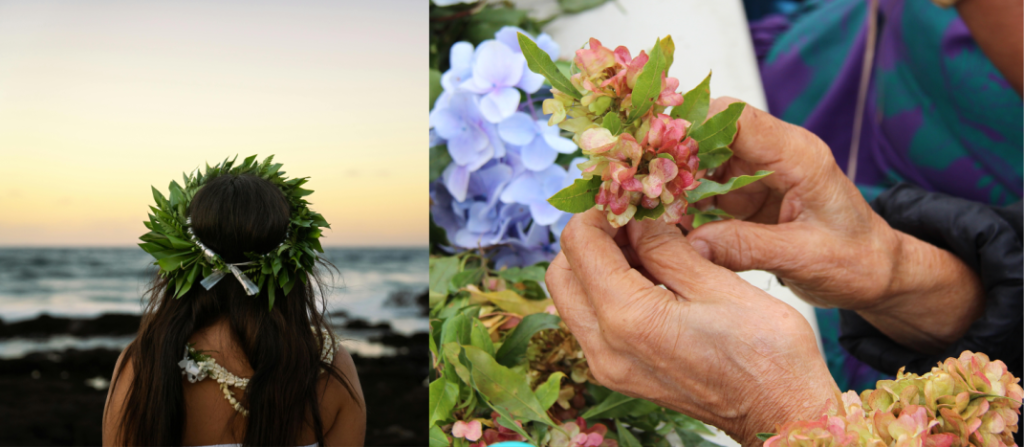
Before encountering this paper, I was generally familiar with the concept of biological or ecological indicators in restoration. For example, as an indicator of stream health, practitioners may track the presence or abundance of a particular fish species that is sensitive to pollution.
However, it would not have occurred to me to use lei as an indicator. Here is how the author explain this choice:
“An example of a biocultural indicator is a lei (plant-based garland on the head or around the neck or shoulders), which is often gifted and worn any time of year for a multitude of reasons including self-adornment, greeting friends and family, and specific life passage events related to the donning of the garland. The extent to which someone produces lei for oneself, or others often reflects the frequency with which they engage with natural environments. An indicator, therefore, that captures the successful gathering of plant material for lei from a natural area would provide insights into: 1) the abundances of materials available in that area which can be an indicator of forest health; 2) the skills of people who harvest plants and steward sites to make lei – skills that may be passed down intergenerationally; 3) the number of people that are going to the forest to collect foliage and flowers to make lei (thus there is knowledge of plant locations and use); 4) plant identification skills of harvesters, as not all plant material is suitable for lei (e.g., some plant dyes stain clothes, some materials are uncomfortable or are too sharp, rigid, or soft, or life span of the harvested plant material is too limited); and 5) perceived or real access to the materials on the lands where the harvesting is done.”
What strikes me about the lei indicator is the wide range of project goals that it tracks. An increase in people making lei from the project area reflects not only the land’s ability to support an abundance of plants but also a certain level of knowledge, skills, and land access within the community. Each of these is a distinct goal of the P-CBSFA, and all of these conditions are necessary for community lei-making to happen. The authors explain that a lot of deliberation went into indicator selection, and that thoughtfulness shines through to me in this particular design choice.
This process has made me more aware and curious about what indicators say about restoration project goals. What noteworthy indicators have you come across?
AI RESPONSIBILITY RUBRIC
This rubric shows human vs AI contribution across stages of developing this article. It was generated by AI and reviewed by human, making adjustments as needed.
--------------------
CONCEPT/PLANNING
Human 55% | AI 45%
[===========.........]
AI: Claude (claude-sonnet-4-6)
Taylan identified the paper and the core topic of interest. Claude contributed to shaping the article's focus and framing through a guided planning conversation.
--------------------
RESEARCH/VERIFICATION
Human 75% | AI 25%
[===============.....]
AI: Claude (claude-sonnet-4-6)
Taylan engaged with the paper independently. Claude assisted with fact-checking specific claims in the article against the source material.
--------------------
WRITING
Human 80% | AI 20%
[================....]
AI: Claude (claude-sonnet-4-6)
Taylan drafted the article. Claude provided a revision of one paragraph, which Taylan further modified before incorporating.
--------------------
EDITING/REFINEMENT
Human 40% | AI 60%
[========............]
AI: Claude (claude-sonnet-4-6)
Claude identified prose and factual issues for Taylan's review. Taylan made all final decisions on edits.
--------------------

AI Tools: Claude (claude-sonnet-4-6)
Citation: Kamelamela, Katie L., Hannah Kihalani Springer, Roberta Ku’ulei Keakealani, Moana Ulu Ching, Tamara Ticktin, Rebekah Dickens Ohara, Elliott W. Parsons, Edith D. Adkins, Kainana S. Francisco, and Christian Giardina. “Kōkua aku, Kōkua mai: an indigenous consensus-driven and place-based approach to community led dryland restoration and stewardship.” Forest Ecology and Management 506 (2022): 119949. Licensed under CC BY-NC-ND 4.0.