
I ended my last article with a brief note about species belonging. I now explore that topic in more depth here. I do this using a framework presented in the 2025 paper by Rayne and colleagues, “Renegotiating Species Belonging in a Changing World“. This is the same paper I reflected on in that last article.
In this paper, the authors introduce four “registers” of belonging: four families of arguments about species belonging that they encountered repeatedly in their research.
According to the four registers model, a species is considered to belong:
- Nativeness: if a species existed in a particular place before the arrival of humans OR arrived without human help.
- Wildness: if human intervention is not required to sustain a population.
- Contributions: if the benefits of a species outweigh the costs.
- Right Relations: if “relevant moral obligations are upheld by human and nonhuman neighbors.” (Rayne et al., 2025)
To help explore these registers, I apply them to three different species in Hawaiʻi, where I currently live. I do so taking on two different roles–a broader-scale decision maker (e.g., policy maker) and a person making decisions about my own land–to demonstrate how the arguments can change depending on scale and perspective; this is especially true for the Contributions register.
A couple things to note before I jump into the exercise. The authors describe the first three registers as “technocratic”–evaluations based on empirical evidence of what is. In contrast, they describe the Right Relations register as concerned with what should be. I find the technocratic registers easier for me to grasp than right relations. This is not surprising given my technical training in mainstream science. Also, the authors point out that nativeness is variably defined in terms of any human arrival or of European arrival, and they point out that the choice in definition is politically influenced rather than purely scientific.
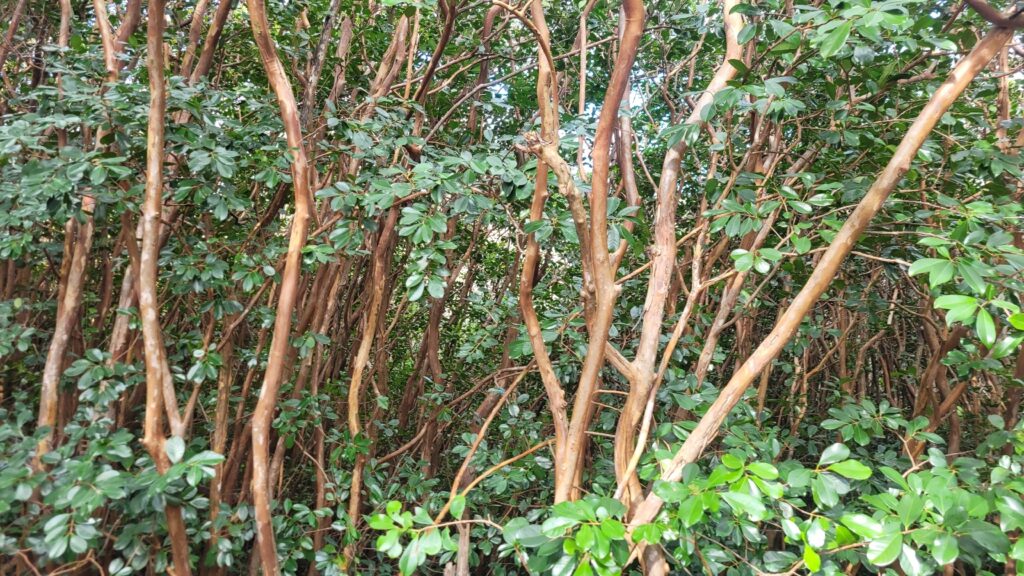
Example #1: strawberry guava (waiawī, Psidium cattleyanum)
Nativeness
This tree species was introduced to Hawaiʻi in the early 1800’s, after European contact with the islands. So, by either of the definitions of nativeness (i.e., existence before human contact or before European contact), this species is not native to Hawaiʻi.
VERDICT: does NOT belong (by either definition)
Wildness
This tree thrives in Hawaiʻi without any human intervention.
VERDICT: belongs
Contribution
This is where things get interesting. On one hand, the fruits produced by this tree are edible to humans and are used to make jam. I also know of at least one case of the tree being used for firewood. Personally, I think it looks cool, too.
But on the other hand, it is known to consume significantly more water than the native trees that it displaces, which affects the water cycle. And this disruption of native forests impacts the habitat of native species. Also, the fruit serves as food for feral pigs, which are also a mixed bag in terms of perceived pros and cons (as I explore more shortly).
From a broad-scale decision making perspective, my understanding is that the costs of this species are generally considered to strongly outweigh any benefits in Hawaiʻi. On the other hand, if I had a plot of land, I might want to have some of these trees around for food and fuel.
VERDICT: it depends
Right relations
As the authors explain, this register is based on moral values specific to a culture. I am a newcomer to Hawaiʻi. If I was a decision maker, I would defer to Hawaiian kūpuna (elders) on this matter.
VERDICT: not my place to weigh in
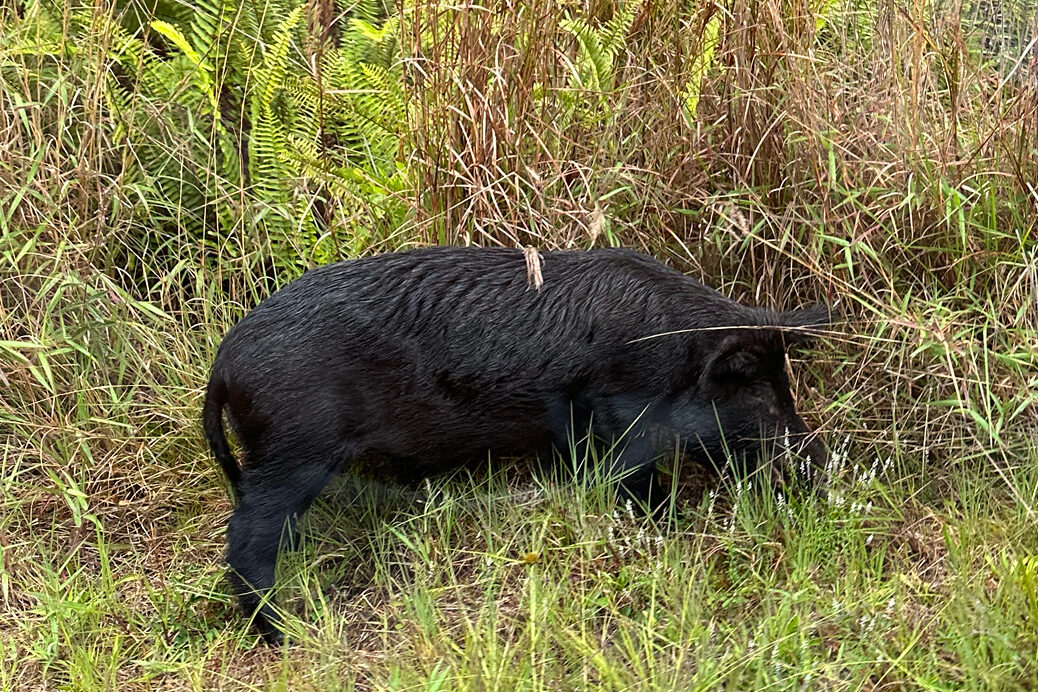
Example #2: feral pigs (puaʻa/Sus scrofa)
Nativeness
My understanding is that pigs did not exist on Hawaiʻi prior to Polynesian arrival. So, if defining nativeness in terms of any human contact, pigs are clearly not native to Hawaiʻi. But it gets more complicated if one defines nativeness in terms of European contact.
There are two complications I know of, and they are somewhat interrelated. The first complication is that at least two separate types of pigs were introduced to the islands at different times: a smaller, Polynesian kind (puaʻa) and a larger, European kind (Sus scrofa). So, if we use the pre-European contact definition of nativeness, puaʻa would be considered native and S. scrofa not.
But then we get to the second complication: my understanding is that the feral pigs currently in Hawaiʻi are hybrids of the Polynesian and European pigs. This blurs the delineation of arrival time (pre- or post-European). Also, as Rayne and colleagues put it:
“Hybrids that carry both native and non-native ancestry are especially likely to be seen as “unnatural” and not belonging, as they destabilize both the ontological unit of species and the native-alien binary (e.g., Fredriksen 2016; Havlick and Biermann 2021; Hennessy 2015).”
VERDICT: does NOT belong by pre-human definition (because arrived with human help) OR by pre-European definition (because they’re hybrids)
Wildness
This one’s much more straightforward. Feral pigs do just fine on their own in Hawaiʻi.
VERDICT: belongs
Contributions
As with strawberry guava, the picture is mixed. On one hand, hunters value these pigs for food and sport. On the other hand, through their digging behavior, feral pigs cause a lot of disturbance to forest understories (not to mention peoples’ yards), create breeding habitat for mosquitoes, and are known to contribute to the spread of Rapid ʻŌhiʻa Death (a disease killing the most widespread native tree species in Hawaiʻi). They also spread strawberry guava seeds.
VERDICT: it depends
Right relations
In this case too, I would defer to kūpuna.
VERDICT: not my place to weigh in
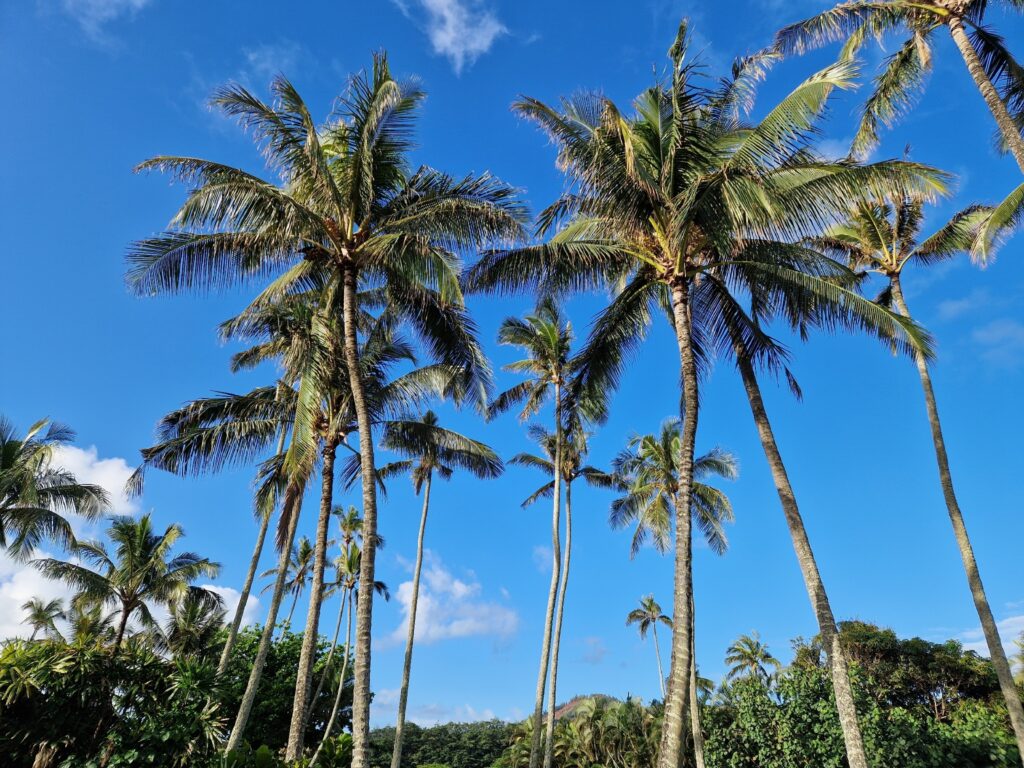
Example #3: coconut (niu, Cocos nucifera)
Nativeness
My understanding is that niu is generally considered to be a “canoe plant”, meaning it was brought to Hawaiʻi in canoes by Polynesians. (Though apparently, there is some limited evidence suggesting that coconut trees may have existed in Hawaiʻi prior to Polynesian arrival.)
VERDICT: does NOT belong by pre-human definition (ignoring the limited evidence to the contrary mentioned above); belongs by pre-European definition
Wildness
My understanding (and observation) is that niu can naturalize and sustain itself without human intervention, especially along shorelines, though it doesn’t spread as aggressively as strawberry guava or pigs.
VERDICT: belongs
Contribution
The coconut palm has great practical and cultural value, both in Hawaiʻi and across the tropics. On a large-scale, I know of no downsides.
At the level of individual trees, there is only one significant downside I can think of: the danger of falling coconuts. So, land managers may decide to remove trees that pose such a threat.
But overall, this species has great benefits and little downsides. So I feel fairly confident saying…
VERDICT: belongs
Right relations
As with previous examples, I do not have the cultural standing in Hawaiʻi to weigh in on this. I would defer to kūpuna.
VERDICT: not my place to weigh in
Reflections
As I mentioned at the beginning of the article, I find the first three “technocratic” registers of belonging easier to grasp. I can do online research, weigh evidence at different scales, and imagine how different people might determine belonging based on these registers.
In some of the examples I presented, the verdict was straightforward (e.g., strawberry guava clearly “non-native” and “wild”; coconut contributions clearly beneficial). But in other cases, there were complications that prevented clear verdicts (e.g., hybridization in feral pigs blurring the “native”/”non-native” binary; mixed positive/negative contributions of strawberry guava).
The right relations register is harder for me to pin down. It’s not because the questions can’t be answered. Rather, it’s because I don’t have the requisite standing in Hawaiian culture or connection to the land to answer them. Right relations arguments about whether moral obligations towards nonhuman entities are fulfilled are not to be made on technical grounds. Rather, they are to be made on relational grounds by community members with ongoing relationships to a place. In short, this is the register about which I understand the least but also about which I’m most interested to engage with and learn more.
Closing
What I have presented in this article is a brief overview of four registers of species belonging that were identified by a group of scholars in “Renegotiating Species Belonging in a Changing World“. I have done my best to understand and explain some points made in that paper, but there are many other points I haven’t touched on here. I encourage the curious reader to check out that paper.
So, when you are faced with questions about species belonging–whether you’re deciding about a plant in your backyard or making plans for a large-scale watershed restoration project–what types of arguments do you consider first, and why?
AI RESPONSIBILITY RUBRIC
This rubric shows human vs AI contribution across stages of developing the article. It was generated by AI and reviewed by human, making adjustments as needed.
--------------------
CONCEPT/PLANNING
Human 80% | AI 20%
[================....]
AI: Claude
Taylan arrived with the core idea: applying the four registers to Hawaiian species, the two-role framing (individual landowner vs. broader decision maker), and the choice of species. Claude contributed by helping refine the one-sentence takeaway, pressure-testing the outline structure, and flagging where threads didn't serve the central point.
--------------------
RESEARCH/VERIFICATION
Human 50% | AI 50%
[==========..........]
AI: Claude
Taylan had worked through the Rayne et al. paper multiple times before the session and brought substantial prior knowledge of the species involved. Claude conducted web searches to fact-check species claims (water use figures, ROD spread, coconut naturalization, pig genetics) and read the paper directly to verify quotes and register definitions.
--------------------
WRITING
Human 85% | AI 15%
[=================...]
AI: Claude
Taylan wrote the full draft. Claude contributed the outline structure from which the draft was developed, which shaped the organization and sequencing of the article.
--------------------
EDITING/REFINEMENT
Human 50% | AI 50%
[==========..........]
AI: Claude
Claude conducted multiple rounds of fact, logic, and language review across successive drafts, identifying the inverted wildness definition, the quote attribution question, and grammatical issues. Taylan evaluated each flag, accepted or rejected suggestions, and made all final wording decisions.
--------------------
IMAGE SOURCING
Human 100% | AI 0%
[====================]
AI: Claude
Taylan independently sourced all images from GBIF, identifying and selecting appropriate CC-licensed observations without AI assistance.
--------------------

AI Tools: Claude (Anthropic)