
Growing kalo for the first time
A few weeks ago, a colleague gifted me with a kalo (taro) plant, my first kalo plant ever. The timing of this was perfect, as I had recently been thinking about growing kalo in my garden.
The reason kalo was on my mind was that I had recently read three papers from the special issue in Sustainability titled Biocultural Restoration in Hawaiʻi. All three of these papers point to the critical biocultural importance of kalo in Hawaiʻi from different angles.
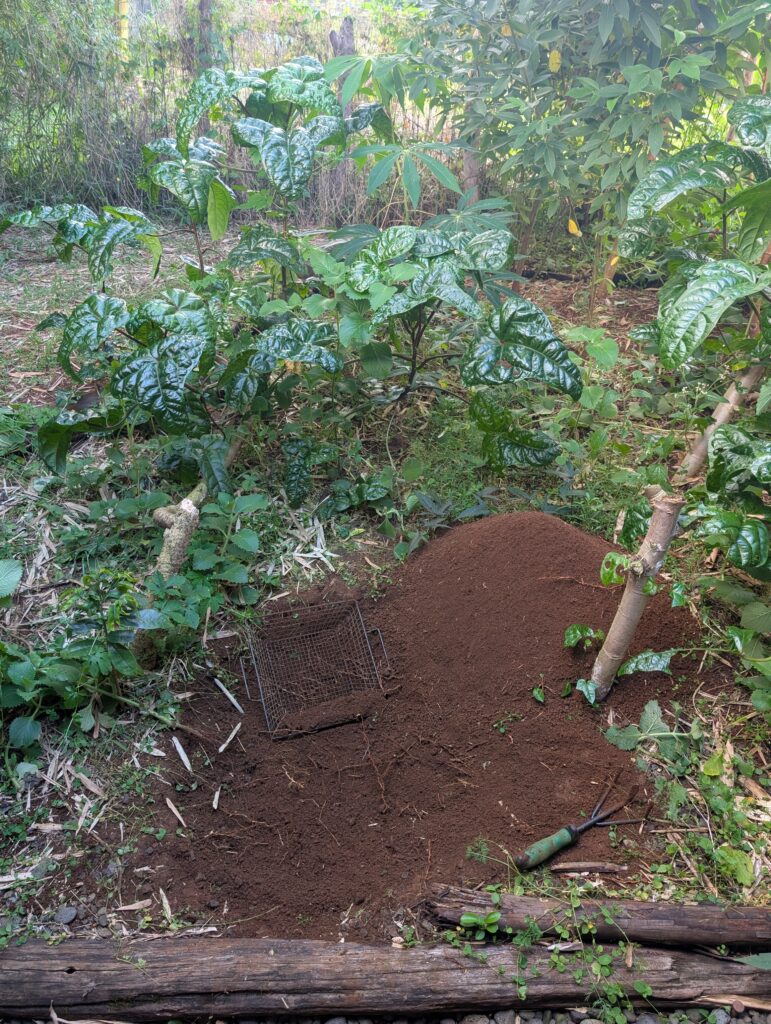
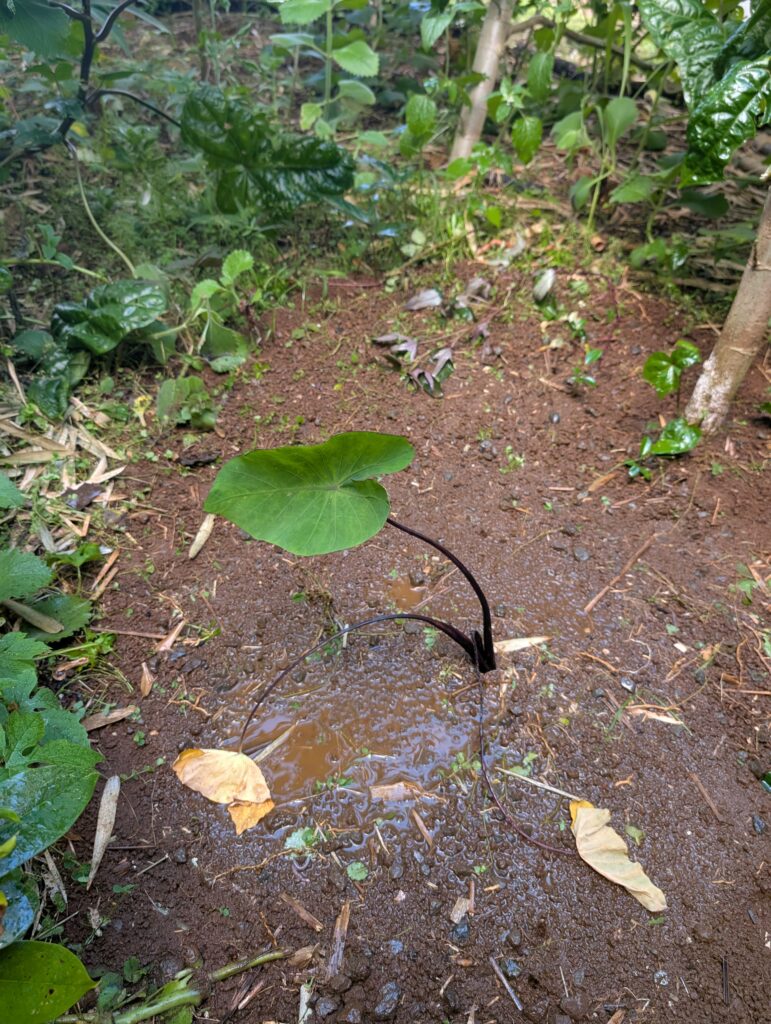
So when it came time to plant this kalo plant in my garden, it felt different. On the one hand, I was just adding one more plant to my garden. But on the other hand, I felt a greater than normal responsibility with this one. Throughout the planting process, I took extra time and care. Before putting it in the ground, I cultivated an extra large area of soil, carefully sifting out gravel and roots and setting aside earthworms to add back in afterwards. I trimmed back the surrounding plants more than usual to give the kalo better access to sunlight. After placing it in the ground, I took my time shaping the soil into a rain-capturing bowl. Throughout this process, I was guided by the question: what does it mean to take care of someone else’s relative in their house?
What I’ve been reading
This question and my sense of heightened responsibility towards this kalo plant were born out of my readings, which highlight the importance of kalo to Hawaiian culture and the critical role of kalo in biocultural restoration in Hawaiʻi.
The paper that first got me thinking about kalo was “The Social-Ecological Keystone Concept: A Quantifiable Metaphor for Understanding the Structure, Function, and Resilience of a Biocultural System“. The authors of this paper adapt the ecological keystone species concept towards understanding how biocultural systems work. One key takeaway for me was the finding that kalo cultivation was dominant or co-dominant in all three of the major, traditional Hawaiian agricultural systems: rain-fed, flooded field, and agroforestry. Pointing to these findings, the authors state, “flooded-field kalo cultivation is the foundation of a Hawaiian cultural landscape; and is, therefore, the key to the biocultural restoration of the Hawaiian social-ecological system.” This fueled my curiosity to learn more about kalo.
While that first paper is largely theoretical and historical, another paper in the same special issue, “Biocultural Restoration of Traditional Agriculture: Cultural, Environmental, and Economic Outcomes of Lo‘i Kalo Restoration in He‘eia, O‘ahu“, documents an active biocultural restoration project of lo‘i (flooded-field) kalo cultivation. This paper describes several benefits that the families involved in this project have reported, including an increased sense of connection with the other families and a strengthened sense of connection to culture and place. The authors also project ecological benefits, such as improved habitat for native birds. These are in addition to the potential economic and social benefits of local food production. In short, this paper illustrates some biocultural benefits of kalo restoration from a real-life example.
My question about caring for someone else’s relative came from reading another paper in the same special issue: “I Ke Ēwe ʻĀina o Ke Kupuna: Hawaiian Ancestral Crops in Perspective“. From this paper, I learned that kalo is understood to be the elder brother of the Hawaiian people and that there is a reciprocal relationship between kalo and kānaka (people) to take care of one another. As such, out of respect, I feel a greater than normal responsibility to care for this plant, even though I am not Hawaiian. It’s as if I were a guest in someone’s house and was given the responsibility to care for their elder brother. How would I uphold this responsibility?
Final thoughts
In some ways, my motivations for growing kalo are like my motivations for growing many other plants: to produce food and improve my gardening skills. But learning about the biocultural importance of kalo in Hawaiʻi has added an extra layer. Though I am not Hawaiian, I still feel an added responsibility to care for this plant that is considered by many Hawaiians to be their older sibling and ancestor. I was holding both of these perspectives throughout the planting process.
It will be interesting to see how my perspective evolves as I continue to care for this plant. And I am curious to hear from anyone reading this who may have their own relevant perspective to offer.
REFERENCES
Bremer, Leah L., Kim Falinski, Casey Ching, Christopher A. Wada, Kimberly M. Burnett, Kanekoa Kukea-Shultz, Nicholas Reppun, Gregory Chun, Kirsten L.L. Oleson, and Tamara Ticktin. 2018. “Biocultural Restoration of Traditional Agriculture: Cultural, Environmental, and Economic Outcomes of Lo‘i Kalo Restoration in He‘eia, O‘ahu” Sustainability 10, no. 12: 4502. https://doi.org/10.3390/su10124502
Kagawa-Viviani, Aurora, Penny Levin, Edward Johnston, Jeri Ooka, Jonathan Baker, Michael Kantar, and Noa Kekuewa Lincoln. 2018. “I Ke Ēwe ʻĀina o Ke Kupuna: Hawaiian Ancestral Crops in Perspective” Sustainability 10, no. 12: 4607. https://doi.org/10.3390/su10124607
Winter, Kawika B., Noa Kekuewa Lincoln, and Fikret Berkes. 2018. “The Social-Ecological Keystone Concept: A Quantifiable Metaphor for Understanding the Structure, Function, and Resilience of a Biocultural System” Sustainability 10, no. 9: 3294. https://doi.org/10.3390/su10093294
AI RESPONSIBILITY RUBRIC

This rubric shows human vs AI contribution across stages of developing the article. The rubric was generated by AI and reviewed by Taylan, making adjustments as needed.

--------------------
CONCEPT/PLANNING
Human 60% | AI 40%
============........
Human provided the core material, personal experience, and key framing decisions. AI contributed to structural development and surfacing connections. Final decisions throughout were human's.
--------------------
RESEARCH/VERIFICATION
Human 80% | AI 20%
================....
Human conducted primary research by reading source material independently. AI assisted with literature searching and fact-checking specific claims.
--------------------
WRITING
Human 90% | AI 10%
==================..
All article prose written by human. AI contribution limited to structural scaffolding used during drafting.
--------------------
EDITING/REFINEMENT
Human 40% | AI 60%
========............
Human conducted initial round of editing. AI conducted multiple rounds of proofreading and fact-checking. Human evaluated all feedback and made final decisions on revisions.
--------------------

AI Tool: Claude Sonnet 4.6