
Over the past month, I’ve had the opportunity to help out with a variety of my colleagues’ projects at work. In this article, I highlight two of these projects. These reflections are written on my personal time, are not part of my official duties at work, and do not represent the opinions of my employer.
This past Monday, I worked with a colleague in a muddy, swampy jungle, measuring the diameters of strawberry guava trees at an established monitoring site. The very next day, I was in a scrubby, dry forest with some other colleagues, roving around looking for native plant species seeds to collect for restoration work.
The contrast of these back-to-back field days was striking to me. Both projects are within the same general field of conservation work (or perhaps more technically speaking, applied ecology), yet the work was markedly different in terms of environment, project goals and timeline, site access, and field methods. In my quest to learn more about restoration ecology and adjacent fields, this contrast was instructive for getting a sense of the range of the types of work that exist in this field.
Different places
For starters, the environments in which these two days took place were quite different. This difference is possible because Hawaiʻi Island–due to its size and elevation range–famously contains most of the world’s climate zones.
As I mentioned, the first day was in a swampy jungle. It was overcast the entire time and occasionally raining. I wore rain gear most of the time, because everything around me was wet. Between the overcast skies, the thick vegetation, and the undulating terrain, I often felt disoriented, not knowing which way we had come in from. Moving through this terrain was usually slow, requiring careful attention to avoid getting tripped up by a vine, being poked in the eye by a branch, stepping on loose lava rock, or ending up knee-deep in mud.
The environment on the second day, working in dry forest and shrubland, felt quite different. While this terrain also had a lot of exposed lava rock, getting around was easier because of the relatively sparse vegetation and absence of mud. Because of this, I was able to see far around me in all directions, so I always knew where I was. And as for weather, it was either sunny or overcast (though never rainy) and breezy. Overall, this was a more pleasant environment for me. Warm, sunny, and dry is my happy place.
It’s interesting to look at differences in access as well. While the terrain of the jungly site made it hard to move around in, it was quite easy to access in terms of permissions. This site was on public land, which we were able to get to by driving on public roads, parking the vehicle, and then walking in, all without having to talk to anyone else. By contrast, getting to the dryland area involved traveling through restricted access areas that required extensive check-in/check-out procedures, and we drove through several gates, which were being used to keep ungulates (i.e., hoofed animals) out of certain conservation areas. That said, both field days involved driving on gravelly roads with 4WD vehicles.
Different project goals and stages
In addition to differences in environment and access, the two projects themselves were also different in terms of purpose, timelines, and methods.
The first project draws on biological control in service of a conservation biology goal. The work site was in a native forest in which the invasive tree species Psidium cattleyanum (i.e., strawberry guava, waiawī) had already been established for decades. The project’s goal is to protect native forests in Hawaiʻi from strawberry guava invasion. The PI (principal investigator) I was working with had established a 50 m x 50 m experimental site in this forest–one of four such sites on the island–to test the efficacy of the insect Tectococcus ovatus as a biocontrol agent for strawberry guava.
Before ever applying the biocontrol agent, the PI had monitored the growth of strawberry guava trees at this site by measuring their diameters at breast height (DBH) annually for about a decade. After introducing the biocontrol about a decade ago, he has continued to track their growth annually. So by the time I showed up to help him out, the project had already been going for a couple decades.
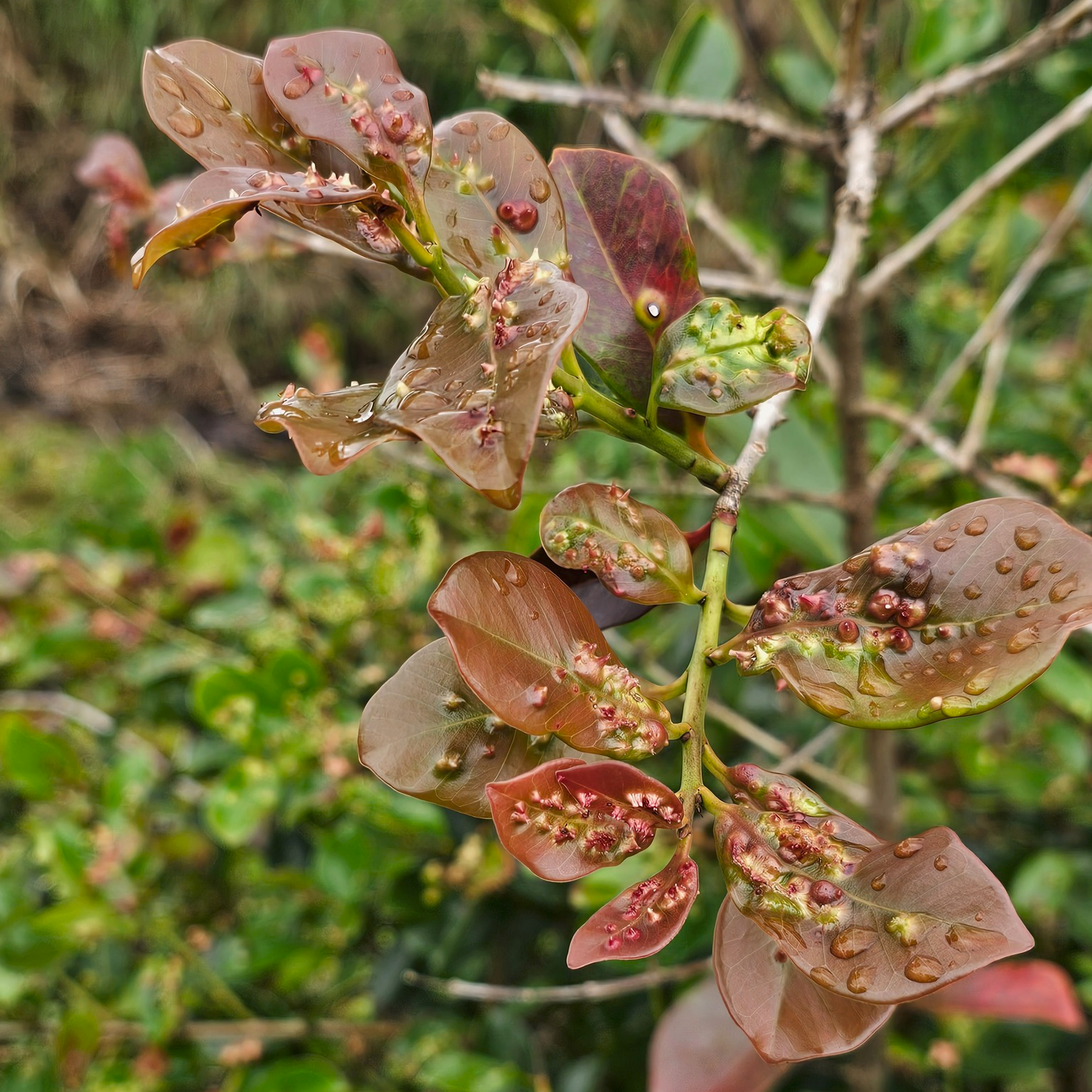
The second project sits more squarely in restoration ecology. The overall goal of the project is to develop more effective methods of restoring degraded dry forests in Hawaiʻi. It’s a relatively new project, still in its first year or so, and on-the-ground seeding experiments have not started yet. Rather, they are still gathering enough native plant seeds with which to perform these seeding experiments. So I helped them with native plant seed collections.
Different work on the ground
As a result of the varied types of work involved with these two projects in their different stages, my experience of the work itself was also quite different.
The strawberry guava work was quite structured and required a high level of precision. Like I mentioned, the core of my work that day was measuring diameter at breast height (DBH) of these trees. Since the guava trees in this site have been measured annually for decades now, I was using a very well-refined protocol. Most of the individual trees I measured had already been measured before. So my job was to systematically go through each tree, locate the mark at which previous measurements were taken, and take a new measurement at that same point.
The DBH measurements were performed using diameter tape or calipers, depending on the size of the tree, and these measurements were taken to the nearest 0.5 mm. Because of this high level of precision, I needed to pay close attention to my measurement technique. In the beginning, before I got the technique down, the PI asked me to re-do some of the measurements, because the numbers I was giving him were outside the range of what he would expect based on past measurements. It took some patience and practice to get the technique down.
Clear communication was another important aspect of the work. The PI was the one recording all of my measurements, so our system of communication was critical for transmitting the data accurately. Our protocol:
- I would say “OK” or “ready” to let him know I had the next set of measurements.
- I would wait for him to respond something like “OK” or “go ahead”.
- I would call out the unique tag number of the tree in question (e.g., “six zero seven”).
- I would wait for him to repeat the number back to me, both to confirm that he had heard it correctly but also to know that he was ready for the next piece of information.
- I would call out the diameter of the tree in millimeters (e.g., “one point two five”).
- I would again wait for him to repeat that number back to me to make sure he got it right.
- In some cases, I would also give him other pieces of information, like if the tree was standing at less than a 45-degree angle from the ground or if it was dead.
Because of the highly structured, systematic, and precise nature of this work, it was mentally taxing. But because my mind was always occupied with a task, the day went by quickly.
In contrast, the dryland forest restoration work was less structured, more exploratory. A good chunk of the day was spent driving around, surveying the terrain for target native species with seeds on them. This proved to be its own challenge, as the majority of target species (e.g., ʻaʻaliʻi, ʻāweoweo, ʻilima, māmane) we encountered did not have seeds at the optimal stage of ripeness. When we did find areas with enough suitable plants, we set out with seed collection bags in hand to harvest what we could. This reminded me very much of my wild hop collecting days from grad school.
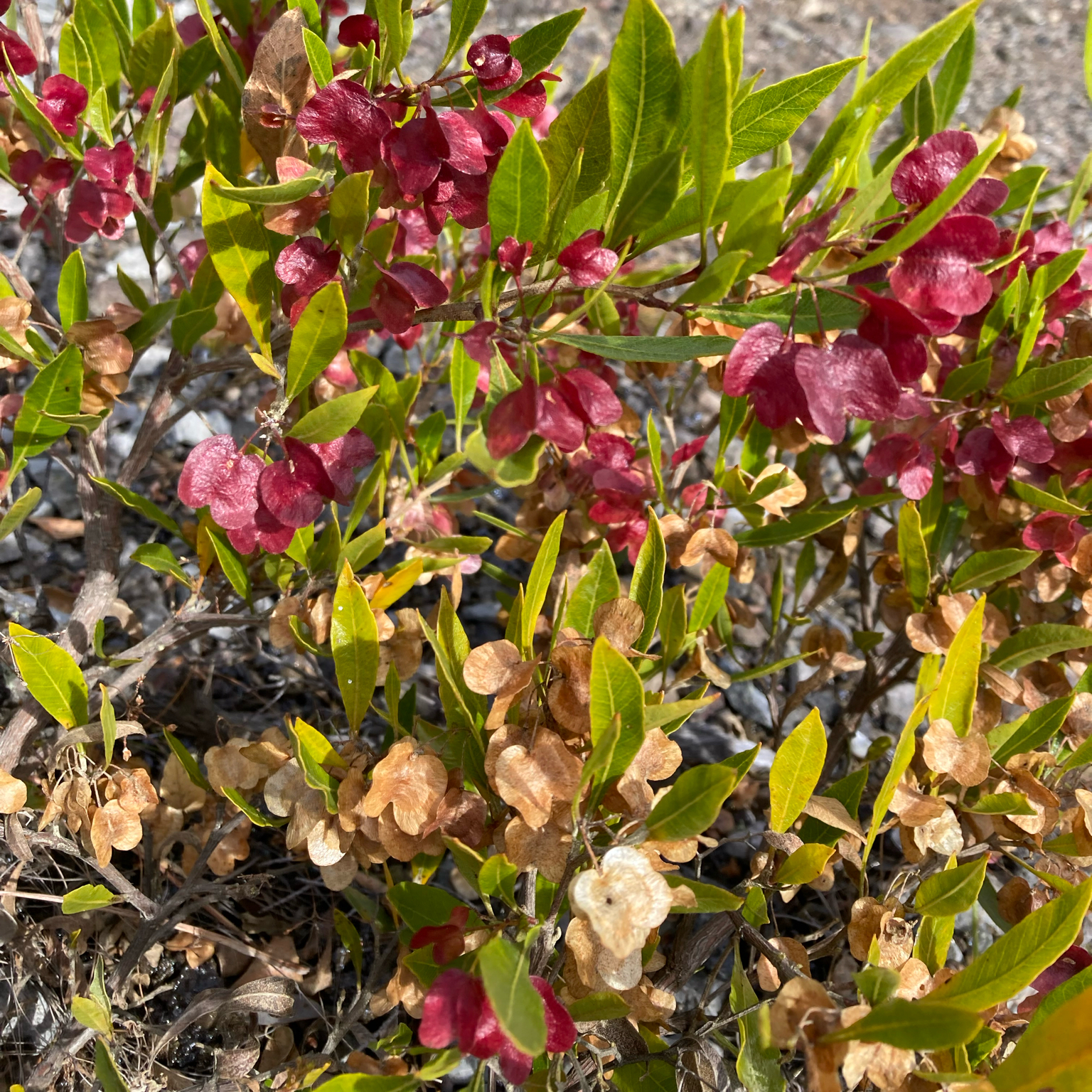
The seed collection work was still methodical in some ways. For example, I needed to keep track of the number of plants from which I collected seeds and communicate this information to my colleagues. I also needed to be selective about which seeds I collected, inspecting for and avoiding seeds infested by insects. But overall, the work was less mentally taxing, more relaxing, and more social than the guava monitoring work.
Closing thoughts
I’m grateful I’ve had the opportunity to experience these different types of fieldwork. They engaged me in different ways, from the methodical, numbers-oriented scientist of my forest inventory work to the gardener and botanical explorer from my grad school days. It was also a nice change of pace going from a wet and muddy jungle one day to dry, sunny, and expansive scrubland the next day. So, even under the umbrella of applied ecology, there’s quite a range of work, and I’m excited to continue learning about it.
AI RESPONSIBILITY RUBRIC
This rubric shows human vs AI contribution across stages of developing the article. The rubric was generated by AI and reviewed by Taylan, making adjustments as needed.
--------------------
CONCEPT/PLANNING
Human 50% | AI 50%
[==========..........]
Collaborative development of the article's angle, takeaway, and structure through extended back-and-forth — multiple outline options generated and compared, with the author selecting and refining the final structure and sequence.
--------------------
RESEARCH/VERIFICATION
Human 35% | AI 65%
[=======.............]
Terminology and disciplinary classification questions were investigated via web research, prompted by the author's own reading and instincts about where the literature did and didn't use certain terms.
--------------------
WRITING
Human 90% | AI 10%
[==================..]
All article prose was independently authored by the human. AI contribution limited to generating title options, one of which was selected.
--------------------
IMAGE
Human 60% | AI 40%
[============........]
Source photographs selected and provided by the author. Technical compositing (cropping, resizing, layout, dividing line) of featured image executed by AI across two rounds of revision per author feedback.
--------------------
EDITING/REFINEMENT
Human 50% | AI 50%
[==========..........]
An initial round of self-editing (cutting and reordering content, grammar fixes) preceded two rounds of AI-assisted proofreading covering logical flow, fact-checking, and line-level corrections.
--------------------

AI Tools: Claude Sonnet 5