
In a previous article, I wrote about the idea that long-term commitment is an important factor in the success of ecological restoration, and that people who have deep, traditional ties to land are more likely to have this kind of commitment. Some things I learned from a recent trip to the Federated States of Micronesia (FSM) have me thinking about this again.
Observations and knowledge
Less than a month ago, I had the opportunity to spend some time in Pohnpei and then in Yap, two of the four states that comprise FSM, which is a small (by population and land area), tropical nation spanning a large area in the Western Pacific.
Before visiting Yap, I had been told that Yap has the most traditional culture of the four states of FSM. And even before I had a chance to see much of Yap, I had heard about the importance in Yapese culture of keeping roadsides clean. From what I understand, almost all land in Yap is privately or communally owned; there is very little government ownership (see this 2004 report, which goes into more depth about the complex land tenure system there). So, while the roads themselves are generally publicly owned, the roadsides are almost all private. And as I understand, there is a high value placed in the culture of keeping one’s land tidy. After spending some time walking and driving around Yap, I indeed observed that roadsides were generally well trimmed and free of trash.
Another thing that stood out to me in both Pohnpei and Yap was the amount of food growing everywhere. The roadsides and other developed areas were full of banana, coconut, cassava, and other food plants. In some areas, it even seemed as though these plants were growing feral.
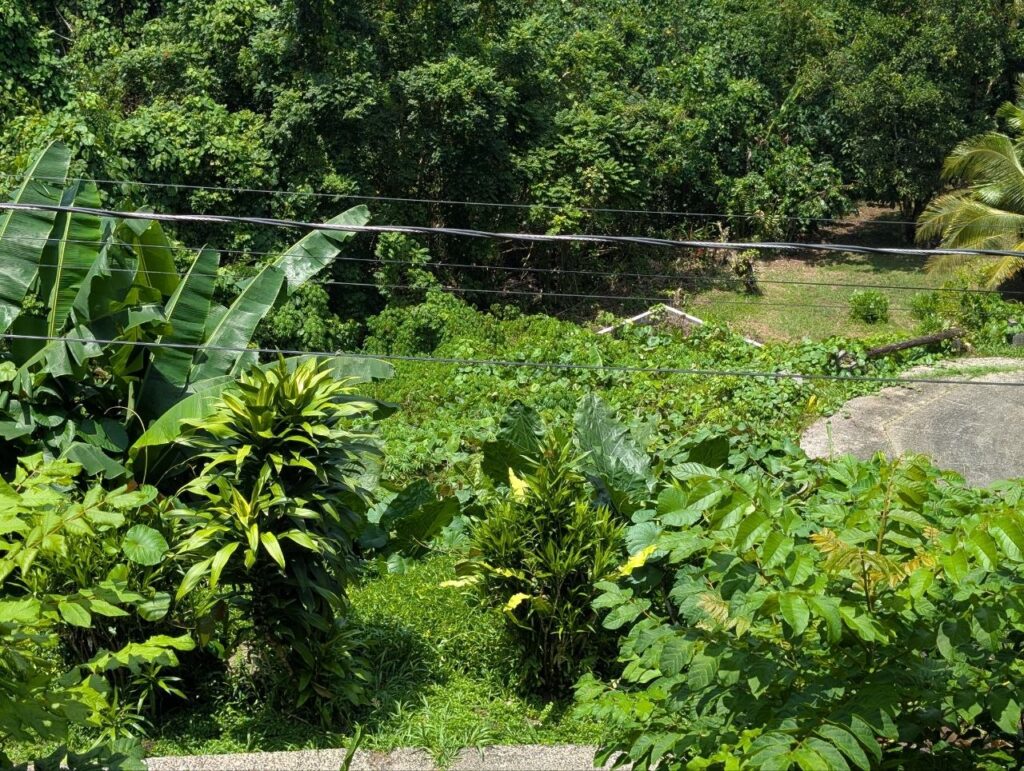
I later discovered some interesting statistics that helped me see this in a broader perspective. According to a Household Income & Expenditure Survey from 2013/2014, 63% of households in FSM engage in subsistence agriculture, with some of these households also engaging in commercial agriculture. For Yap, the figure is 90%. This statistic especially stands out to me as consistent with strong ties to the land, although engagement with agriculture is far from the only factor determining connection to land.
Reflections
While my observations of and knowledge about land and culture in FSM are far from exhaustive, the picture forming in my mind is of a place with strong ties to the land. This seems like a positive quality for ecological restoration success.
But the land ownership situation in Yap especially brings up another question for me. From what I understand, the land is composed of many relatively small parcels that are divided among various owners and family groups. Considering this in contrast to the situation in the continental US, where some restoration projects are undertaken within large, governmentally owned parcels, I wonder what it would be like to coordinate large-scale restoration work in a landscape with so many different owners.
AI RESPONSIBILITY RUBRIC
This rubric shows human vs AI contribution across stages of developing the article. The rubric was generated by AI and reviewed by Taylan, making adjustments as needed.
--------------------
CONCEPT/PLANNING
Human 60% | AI 40%
[============........]
The topic, observations, and takeaway originated with the author, who also narrowed the piece to a short set of observations and wrote the final simplified outline. AI helped sort which material was suitable to publish, suggested earlier outline structures, and helped frame the closing question, and the author made the final decisions.
--------------------
RESEARCH/VERIFICATION
Human 40% | AI 60%
[========............]
The author supplied the observations and chose which sources to cite. AI did most of the source searching and retrieval, checked the cited statistics against the original survey factsheet, and flagged claims that needed softer wording or a source.
--------------------
WRITING
Human 95% | AI 5%
[===================.]
The author wrote the full draft independently. AI contributed occasional suggested wording that the author chose to adopt or adapt.
--------------------
IMAGES
Human 100% | AI 0%
[====================]
The photo was taken and selected by the author.
--------------------
EDITING/REFINEMENT
Human 30% | AI 70%
[======..............]
The author did one round of sentence-level editing before sharing the first draft. AI then led the logic-checking, fact-checking, proofreading, and title-brainstorming passes, and the author reviewed and implemented most of the suggested changes.
--------------------

AI Tools: Claude Sonnet 5.5